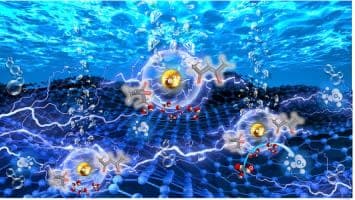

Water splitting
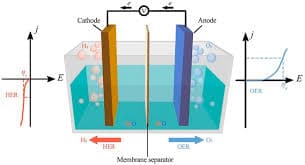
Focuses on splitting water molecules (H₂O) into hydrogen gas (H₂) and oxygen (O₂) using external energy sources, typically from sunlight (photocatalytic), electricity (electrocatalytic), or a combination of both.
| Type | Brief Explanation | Example |
|---|---|---|
| Photocatalytic | Uses sunlight and semiconductors to decompose water. | TiO₂, perovskite |
| Electrocatalytic | Uses electric current and catalysts (usually transition metals) | Pt, NiFe electrodes |
| Photoelectrochemical (PEC) | Combines sunlight and electricity within an electrochemical cell. | PEC with semiconductors such as BiVO₄, hematite |
Research Focus
-
Catalyst Materials: Must be inexpensive, stable, and efficient (e.g., Fe₂O₃, MoS₂, perovskite).
-
Energy Conversion Efficiency: How much light/electrical energy is converted into H₂.
-
Long-Term Stability: Materials should not degrade or corrode in a short time.
-
Production Cost: Reducing cost for commercial applicability.
Related Publications
Dive into these recommended publications for further insights and inspiration.
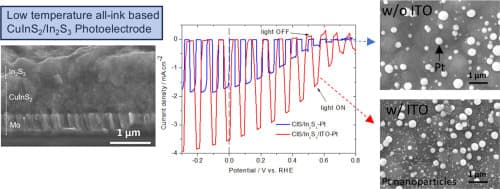
Improved Photoelectrochemical Water Splitting Using ITO-Enhanced In2S3-Modified CuInS2 Photoelectrodes via Low-Temperature All-Ink Processing
Brian Yuliarto, Xorell Ivanov
Surfaces and Interfaces 2025
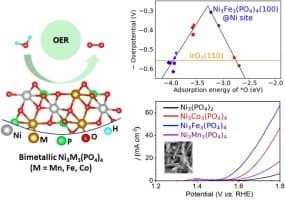
Oxygen evolution reaction activity of Ni3 (PO4) 2 and bimetallic Ni3M3 (PO4) 4 (M= Mn, Fe, Co): Insights from DFT and experimental validation
Brian Yuliarto, Ni Luh Wulan Septiani, Clara Caroline Mariani
Fuel 2025
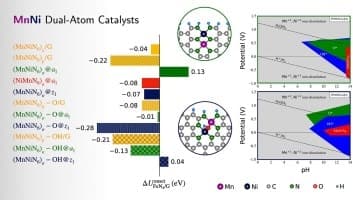
DFT study of oxygen reduction reaction activity and stability on Mn-Ni dual-atom electrocatalysts anchored at graphene edges
Ahmad Nuruddin
Applied Surface Science 2025